Recovery Act Money for SST Research

NASA Solicitation: Recovery Act: Advanced Concept Studies for Supersonic Commerical Transport Aircraft Entering Service in the 2018-2020 Period

"RECOVERY ACT - THIS NOTICE IS PROVIDED FOR INFORMATION PURPOSES ONLY. THIS OPPORTUNITY IS AVAILABLE ONLY TO LOCKHEED MARTIN CORPORATION, LOCKHEED MARTIN AERONAUTICS COMPANY, PALMDALE, CA.

The Supersonics Project is aligned with the Aeronautics Research Mission Directorate (ARMD) principles of maintaining intellectual stewardship of aeronautical core competencies for the nation in the supersonic flight regime and of focusing research in areas that are appropriate to NASA's unique capabilities. The Project supports the Fundamental Aeronautics Program's (FAP) strategy of developing systems level multidisciplinary capabilities for supersonic civilian and military applications."


Advertise Here

27 Comments

| Leave a comment

DARPA Vulcan is also dealing with this...

Oh yeah ... the first A. I always forget about the Aeronautical part of the program.

William Proxmire would not be pleased. I am though. We need to keep aeronautics research alive.

Proxmire is currently located in a more thermally challenging environment and likely isn't giving much thought to either dairy products or aerospace.

Likely giving lots to Air Conditioning, Asbestos Underwear and Ice Cold Lemonade.

"THIS OPPORTUNITY IS AVAILABLE ONLY TO LOCKHEED MARTIN CORPORATION"

Proxmire indeed. I think I'll buy a seat on that "commercial" SST from the same fellow over there selling bridges.

user-pic

Reality Check for SST or Sonic Cruiser.

Cmon folks we need 3 things before we start seeing sonic cruising or even SSTs plying the skies again.

1) Sonic boom abatement to allow for overland supercruise. Okay, I'm ready to believe this one might happen.

2) Fuel so cheap the extra fuel burn is not a factor. Can you say 1960's? Look up the Boeing 20007 and its fuel non-economy.

3) A functioning economy. We're going the wrong way on this one. For some reason we keep making the economy less functional .... Now where did I put that credit card .....

Andrew

Well, while we're at it - why is it, then, that NASA has to engage in this field? With respect to military applications, why not let the DoD do it? With respect to civilian applications, why not let the private sector do it?

The reason for a civilian space program is simple: it's 'the final frontier', and we want to invest in it as a community since nobody else will. But aviation research? Why not let it be done by those who will use it, namely the private aviation companies? I'm not seeking to offend anyone, but couldn't those money be spent more wisely on, say, space?

user-pic


Anders' point brings a few questions to my mind. Is NASA doing SST studies because someone has requested it? NASA has been doing SST work since the death of the US SST program. Offhand, does anyone know if NASA was doing that work in the 1960's, or was that mainly a Boeing/Lockheed effort?

If the aeronautics in the first "A" of NASA were in demand I would think that what the airlines really need is fuel efficiency, fuel efficiency, and maybe a bit more fuel efficiceny. Has someone really requested more SST work? It makes me GUESS that maybe NASA might have been told to do some aeronautics work, and absent a request from the industrial sector decided to dust off all the old SST work because it was cool.

Anyone out there know the true origins of the work?


Andrew

I got a lot out of the High Speed Civil Transport program, although I don't think the rest of you did. It's interesting that most of the spin-offs seem to have gone to the F-35 that rarely, if ever goes supersonic. Much of what is now called synthetic vision started or at some point was funded by HSCT too.

Personally, I don't see any big future in low boom technology. There are too many things that can "lens" shockwaves from low boom aircraft in such a way that their impact can be substantial. These include phenomena common to air travel such as turning or local heat pockets above a city. Where I grew up we heard sonic booms all the time. Big f'ing deal. Damn tree hugger Luddites keeping us all safe from progress again.

The real issue is economics as several have noted. Unfortunately our aircraft designs suffer from the same idiotic "design by committee" approach as our rockets. There are routes, especially in the Pacific Rim where aircraft could easily make money flying Mach 2 if they were designed by someone who knew what the hell they were doing. Unfortunately none of NASA's research has discovered a way to replace Kelly Johnson or Werner Von Braun yet, despite the fact that any idiot could figure out the first step would be to put their position back on the org chart.

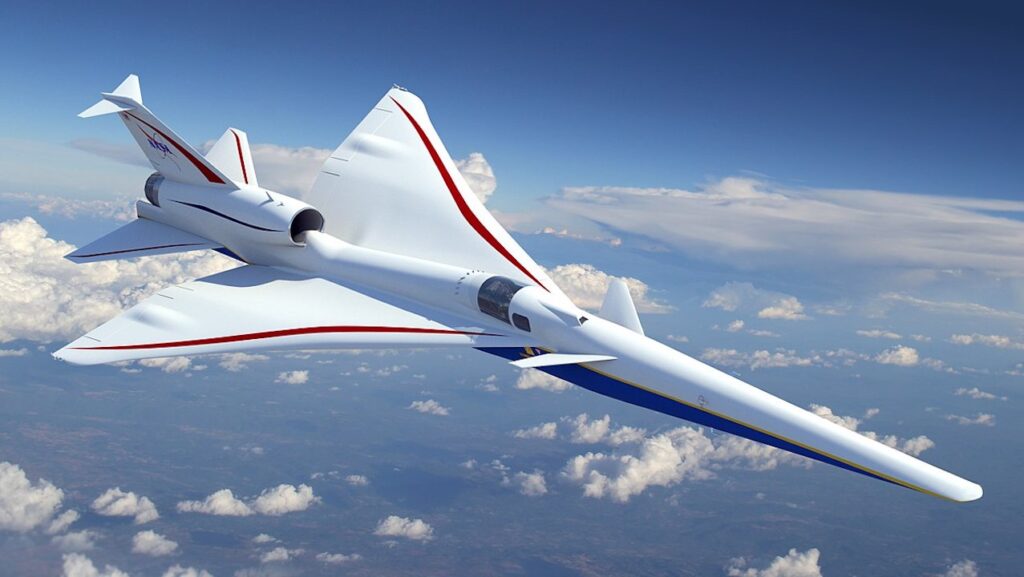
I wonder if the dumbass who came up with the cartoon above has figured out that having the engines ingest the tip vortex from the canard is a bad thing yet? Makes me want to weep.

Andrew:

Check your facts. That was the Boeing 2707.

And don't worry about the fuel economy. Nobody in their right mind is going to believe that advances in aeronautical engineering have made any kind of impact on fuel economy in the last fifty years.

After all, airlines wouldn't care if you saved them 10% of their fuel costs.

(Everybody, while he's thinking about this, slip away.)

If designing new aircraft and new engines to go supersonic whilst minimising the CO2 produced go the full way and build planes that burn liquid hydrogen. Up grading a few major airports is not difficult.

Perhaps someone will post the correct number>> With a fuel burn of 2 to 3 times the BTU's per passenger mile of a subsonic passenger jet, I ask, how does anyone justify a civilian SST in this day and age?

The notice does mention "military applications." I suspect that the military angle is the most important thing here. If a commercial airliner were the end goal, I would think it would make more sense for Boeing to get the money.

I believe that the military applications will take the lead on this project as the advantages of such uses would outweigh any commercial applications.

I'm kind of sad we did not pursue the 2707 to fruition.
Yes the realities of fuel consumption, noise, and the raw engineering difficulty might have made is a bad idea for the airline industry.
But having things like supersonic airliners are also a source of national pride, and who knows? Maybe a US attempt would have come to a different conclusion than the concord.

As technology improves, its worth looking into every now and then.

"Perhaps someone will post the correct number>> With a fuel burn of 2 to 3 times the BTU's per passenger mile of a subsonic passenger jet, I ask, how does anyone justify a civilian SST in this day and age?"

Think FedEx.

We had an SST in the mid-60's, it was called the XB-70 Valkyrie. Of course, it was military bomber. But it was basically a Concorde, complete with the tilt-nose for take-off and landing. It was cancelled after a mid-air collision with a chase plane. I don't think an SST is not economically viable for the commercial airline industry. It's all about lower prices, not faster travel. Given the choice of a $500 ticket for a 6-hour trip vs. $1000 for a 2-hour trip, the average passenger would pick the $500 ticket. And there's no way an SST could be as low as double the average subsonic ticket, probably more like 20 times.

…“passenger would pick the $500 ticket”

In fact, the major airlines make the overwhelming bulk of their revenue from the so-called “premium passengers”, the first and business class travelers.

The world economy will recover and continue to grow. The break-even point will come in the next couple of decades when there are enough premium passengers together with a stable supply of synthetic jet fuel justify SST development.

Shaped sonic boom aircraft could potentially fly overland routs with active guidance from a network of wind profilers with radar acoustic subsystems (gentle readers can learn more about these on NOAA’s web site then put two-and-two together).

It's not hard to make a Mach 2 airplane pay. Get one across the Pacific in less than half the time it takes a conventional airplane and you're talking about making a trip that would normally take a business traveler a week taking them a couple of days. It's easy to make those numbers make sense for many companies.

By the way, the XB-70 wasn't killed by the crash. NASA's work with the airplane after the Air Force program had already been canceled was killed by that accident. What they said killed the XB-70 was the ICBM. What really killed it? That's harder to say. I've long been a proponent of a Mach 3 bomber. It would be much cheaper to build than another B-2. That composite stuff costs a friggen fortune and it's difficult to maintain. If we build an all steel Mach 3 bomber that used shape stealth only, it would be both low cost and high availability. Hell, look at the F-22's mission capable rate, it's down below 60%. The main driver in that number is the stealth edges and coatings. So get rid of them, I say, and use low cost shape stealth and speed. Speed is life still works. The SR-71 proved that enough times.

Wow, 20+ comments and we can only find references to old prototype projects in the discussion. Not one reference to Concorde, you guys are a little bit too US-centric sometimes, but I suppose it's called NATIONAL Agency for something...

Anyhoooo, if the aforementioned commercial service has shown one thing, it is that demand may or may not be there for this thing, and that Andrew has it right. Until we figure out a way with the sonic waves and a way of running planes with CO2-neutral fuel (either natural fuel or synthetic fuel produced with clean energy) there isn't much point in looking at these heavenly equivalents of gaz guzzlers (or should it be sports cars). Although I have to say, the day they retired it (for an essentially wrong reason) I did believe we had a technological recession, as we essentially lost a transport ability.

Now, trying to finally figure out viable SSTO technology, that's an interesting goal...


A.

Concorde was an unspectacular design that could barely make it across the Atlantic. I suppose that was good enough for its day, but not good enough for today. And if you want to go carbon neutral, don't take an airplane. There is only one technology I see that might make airplanes stop exhausting carbon is beamed energy from either ground or satelite sources. Any fuels without carbon have too low of an energy density for aircraft.

Single stage to orbit is for idiots. Bad ideas take on a life of their own. Good ideas get classified.

I saw a Concorde reference.

"The Supersonics Project is a broad based effort designed to develop knowledge, capabilities and technologies that support all vehicles that fly in the supersonic speed regime."

Ok, I know what this is. This is a way to steer some NASA money to that supersonic business jet program Lockheed has been working on. They've never been able to get NASA money for this before because it is seen as a subsidy for the rich, which is exactly what it is. I guess by calling it reasearch that can benefit "all vehicles" that fly supersonic (there are so many of them) they avoid the "subsidy for the rich" label through obscuration of purpose. This might be a good contract for NASAwatch to keep an eye on. I wonder what the amount of the contract is? I didn't see it on the release the link sent me to.

All you rocket boys with your rocket toys will remember the first A in NASA when Ares/Constellation finally gets sent to an early grave and the "mean, green Obama machine" redirects a chuck of the funding to develop the the next generation of subsonic "green" aircraft....

But that would NEVER happen, right? National pride, China, "launch gaps", blah blah blah - they certainly are more relevant to the planet than dealing with aircraft that are pumping CO2, NOX and all manner of particulate matter directly into the most sensitive part of the atmosphere.

I've seen the lone surviving XB-70 at the Air Force Museum in Ohio. It is indeed quite impressive, maybe even moreso than the Concorde (which I've also seen up close in NYC on display next to the Intrepid).
I would very much like to see a commercially viable SST, and am disappointed in the lack of progress in that area.

A supersonic business jet that can cross the Pacific has been the holy grail of business jet design for quite a few years now. The demand for such a jet has only increased since 9/11 and the increased hassle of normal airline travel. Although there is a stigma of subsidizing the rich associated with public funding for this supersonic business jet program, the technology would be directly applicable to scaled up passenger jets. I have to wonder if it's really wrong to help a jet that's in a viable market screaming for a product when the long term benefits of such a program could conceivably be available to all.

When I look at the new Daussalt Falcon 7X I see one of the best aerodynamically integrated vehicles I've seen since the L-1011. With a few changes, I'm sure it could easily cruise at Mach 0.95 just like the L-1011. When I see something that's well done like the 7X it really pisses me off when con men start pedaling crap like this Aerion. Notice the nice vortex strakes feeding their turbulence directly into the engine intakes. I could go on about what a piece of crap this is, but it's not worth the typing.

Anyway, there's a big push for a supersonic business jet. Almost every biz jet manufacturer has some effort in that area. In the passenger jet arena, on the other hand, there's no effort at all going to supersonic travel. NASA might as well help where their help is most likely to count. Nothing came of HSCT because Boeing, once it bought McDonald Douglas publicly stated they were not interested in supersonic passenger jet development. If Lockheed is interested in the red hot business jet market, maybe NASA should help.

I have the distinct impression (as a non scientist) that there is no way to a fuel efficient (cost efficient) SST. Even flying above the atmosphere, to escape air resistance and sonic booms, appears unhelpful. Up there you have negligible lift and would need a large liquid oxygen supply, which is costly, heavy and dangerous.

Is there really any hope for an SST?

Leave a comment


calendar

Events
Launches
Your Event

Monthly Archives

Mortgage Lead

Play online bingo at the top bingo sites.

Interested in Space Travel, try the next best thing, name your own star.

Online Bingo

Hier finden Sie die neuesten Casino Bonus Codes von fuhrenden Gaming-Sites.

Forex like a Pro with a leading forex broker.

About this Entry

This page contains a single entry by Keith Cowing published on September 19, 2009 1:34 PM.

Orion Gets Recovery Act Money was the previous entry in this blog.

WiFi On The Moon is the next entry in this blog.

Find recent content on the main index or look in the archives to find all content.


- Find brilliant bingo sites and start to win

-

- Trade Forex like a Pro

- Die besten Seiten fur online roulette spielen, Spielstrategien und Tipps.