Infographic of the Day: We're Getting Good at Going to Mars, Fast Company
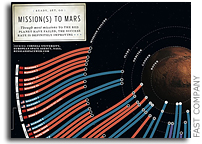
"Maybe ever since the Moon landing, it's been pretty easy to overestimate the success of our space programs--when we want to go somewhere or launch something, we just do it, right? In actuality, space exploration remains a high risk endeavor, as the various Space Shuttle disasters have proven. And going to Mars? Maybe it's out closest planet, but going there isn't as easy as it seems. To prove it, here's a clever graph of all the missions ever sent to Mars. As you can see, it's basically a bar graph; missions to Mars as listed chronologically, and the mission result is coded by how close the corresponding bar reaches to Mars."
Missions To Mars - All Of Them
Venus is our closest planet, not Mars. Speaking of which, a graphic of Venus missions would be interesting. The Soviet Union was extremely successful with Venus.
Right now Mars is closer. Next May, Venus will be closer.
Correct me if I wrong, but when averaged over time the closet planet is Mercury.
SkyWatcher, technically you might be correct in that averaged over time the closest planet is Mercury, but that is pointless. We try to fly to planets when they are as close as possible to Earth, so the smallest distance at that point in time is what matters, not the average. The distance to Mercury when Mercury is closest to Earth is farther than Earth to Mars and Venus.
Yep, Mercury is closer on average. The Sun is even closer still on average!
The distance (now or average or closest) of course has nothing to do with how hard it is to get there. What matters is the energy to get there. In that regard, Venus tends to have a lower C3 than Mars for the lowest energy Type 1 or Type 2 (direct) transfer. Around 7 or 8 for the best transfers to Venus, and around 8 to 9 for the best transfers to Mars. They all vary quite a bit from opportunity to opportunity. In terms of transfer energy, you could say that Venus is a smidge "closer" than Mars.
You would never do a direct transfer to Mercury since it's so expensive, but rather swing by Venus, possibly a few times, to lower the heliocentric energy. Getting to the Sun (or close to the Sun) is even harder, and usually a Jupiter flyby is the way to go.
Leave a comment

- 7 Feb: NASA Commercial Crew Forum [New]
- 7 Feb: NASA Talk Features Pioneer Researcher and Inventor [New]
- 8-9 Feb: NASA and Industry Join Forces for Virginia Aerospace Day [New]
- 9 Feb: NASA International Space Station Advisory Committee Meeting
- 9 Feb: NASA Hosts Special Event With Recent Space Station Residents [New]
- 10 Feb: Media Invited to see Space Hardware Bound for Japan [New]
- 10-11 Feb: Astronomy and Astrophysics Advisory Committee Meeting
- 11 Feb: NASA Astronaut to Honor Black History at Virginia Air and Space Center [New]
- 13 Feb: ESA Briefing on New Results from Planck Mission
- 14 Feb: Astronauts' Discussion Of Recent International Space Station Mission
- 14 Feb: NASA Tweetup With Space Station Astronaut Ron Garan
- 15 Feb: STA reception with Mike Coats
- 15-16 Feb: 15th Annual FAA Commercial Space Transportation Conference
- 21 Feb: ISU 16th Annual Symposium: Sustainability of Space Activities: International Issues and Potential Solutions
- 22 Feb: 2012 International Geoscience and Remote Sensing Symposium
- 22-23 Feb: 2012 NASA PM Challenge
- 23 Feb: NASA Advisory Council Science Committee Planetary Science Subcommittee Meeting
- 26-28 Feb: Space Exploration Alliance 2012 Blitz
- 27-28 Feb: Second International MEPAG Meeting
- 27-29 Feb: Next-Generation Suborbital Researchers Conference
- 28 Feb - 1 Mar: 4th Annual NASA STEM Educators Workshop Series
- 2 Mar: NASA Glenn Tweetup Celebrating 50th Anniversary Of First American To Orbit Earth
- 6-7 Mar: JPL Hosts High-Tech Small Business Conference
- 22 March: Symposium on Suborbital and Small Satellite Missions
- 22-23 Mar: NASA Adminstrator Bolden Speaks at Aerospace and Defense Conference [New]
- 27-29 Mar: 50th Robert H. Goddard Memorial Symposium
- * Submit Your Event | More Events *


The success rate for outer planets missions has actually been higher than for Mars missions. Unless I'm missing something, I think humanity has a perfect outer planets record so far, not counting problems like the Galileo high gain antenna problem.