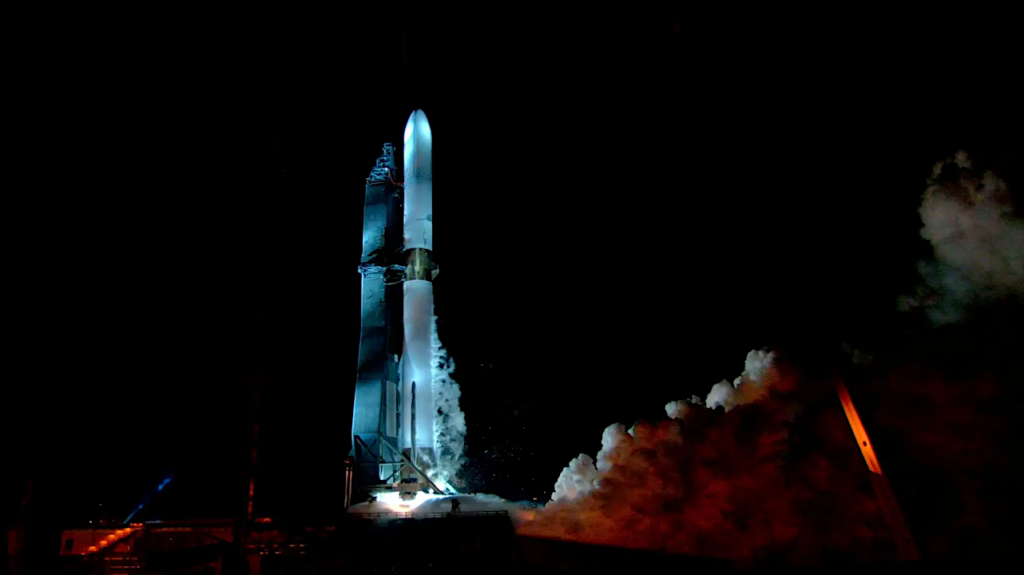
Orion Starts Test Phase

Orion Starts Testing Phase, Ken Kremer

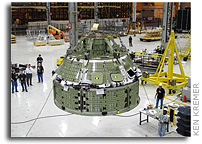
"The crucial pressure testing phase for NASA's pioneer Orion crew test capsule has begun inside the NASA Michoud Assembly Facility (MAF) in New Orleans, Louisiana. It will be subjected to a wide ranging and stringent testing regime by the joint NASA/Lockheed Martin Orion team at multiple different facilities over the coming year to validate the spacecraft design."


Advertise Here

19 Comments

| Leave a comment

Folks:

LockMart still doesn't get it. They're not building a capsule but are over-milking a cow til it falls over and dies. They have no launch vehicle that can even lift their capsule plus payload plus launch escape system.

They could learn a lesson from Boeing. They decided to build a capsule only this big and that heavy so current launch vehicles could haul it to space.

Deep space manned vehicles will be just that... and no more. It's foolish to drag a re-entry capsule along on a deep space voyage unless you're planning on throwing away the rest of your spacecraft every mission (also foolish).

Your lifeboat stays in orbit where it belongs whether it's a capsule or a space station.

I'd make book on the Orion capsule never flying and call it a long term investment.

tinker

Lockheed Martin's original CEV concept for Sean O'Keefe's RFP had a mission module, optimized for in-space operations and a lifting body return vehicle optimized for safe landings on an Earth runway: http://en.wikipedia.org/wiki/File:CEV_Lockheed_Martin.jpg.

However, in order to win Mike Griffin's Constellation contracts, Lockheed Martin just went ahead and did what NASA told them to do. They returned to the Soviet design bureau posture.

You see, once Dr. Griffin assumed the helm of NASA, it was determined that the best ideas in space exploration originate from central planning inside the agency.

It's foolish to drag a re-entry capsule along on a deep space voyage unless you're planning on throwing away the rest of your spacecraft every mission (also foolish).

That does not necessarily follow. There are architectures that bring the crew back immediately upon Earth encounter on the return leg using a reentry vehicle, and the mother ship with no crew flies by Earth and uses low thrust to return later to Earth orbit for reuse.

Keeping the time in space for the crew at a minimum is important both for health and to keep down the mass for supplies.

The link 2 up is broken - either kill the period at the end or just follow http://en.wikipedia.org/wiki/File:CEV_Lockheed_Martin.jpg

It was a very sexy design. Not too much wing, not too little. Griffin indeed killed it.

I agree that CEV was an abortion as soon as government told engineers how to build it.

Another conveniently forgotten piece of history.

Sure an architecture could be contrived that does what you are saying but there is little logic to what you suggest.

Its a lot of unnecessary mass with no purpose to carry along on a multi-billion mile, multi-month expedition. And after many months en route, you are going to save a matter of hours or days, returning directly. And you are going to subject your crew, likely more significantly debillitated, to extra high G forces, and the shock of parachutes, and the hazards of an ocean landing. And to begin with, if the prime purpose is earth return, the capsule did not need to be that large (which necessitated the ocean landing, which required the extra mass for launch, which causes increased safety risk for the crew, which increases mission cost at all stages).

The fact you identified the other portion of the craft, the one that stays in space, as "the mother ship" says a great deal about the irrationality of a return capsule as large as Orion.

"LockMart still doesn't get it. They're not building a capsule but are over-milking a cow til it falls over and dies. They have no launch vehicle that can even lift their capsule plus payload plus launch escape system."

What an asinine comment. Lockheed is under contract to their customer (NASA) to build the Orion vehicle. NASA sets the Level 1 and Level 2 requirements which LM must meet. NASA defines the top-level schedule. Until such time as LM receives a stop-work order or the reqt's/schedule are redefined, they are obligated to continue to deliver to the contract they are under as any other "commercial" aerospace firm would do.

What Boeing chooses to design is their choice as they are there own customer (along with Bigalow). They are funding that design on their own nickel and to their own set of requirements.

GuessWho:

"Until such time as LM receives a stop-work order or the reqt's/schedule are redefined, they are obligated to..." squeeze the teat of the cow that fed them til it falls over. Not only that but they are running a propaganda campaign to make it look like they still had a viable product. They sure convinced you. I was looking for a sucker to bet with...

Let's see LockMart go it alone and supply a launch vehicle and a mission for that "piece of crap" (check YouTube for a song of the same name by Neil Young, it can become their theme song).

tinker

So how many billions is it going to cost to build capsule?

It's time to fund COTS D. We need affordable domestic transport to LEO ASAP. Let NASA start working on the craft that will take us from LEO an beyond. Orion is not that craft.

Actually Miles, there's very *little* logic to what you are suggesting.

The issue isn't "saving time" (or any of the other - relatively trivial - issues you cite), it is shedding energy. How are you proposing to slow down your interplanetary craft from a Mars-Earth trajectory such that it can dock with a companion vehicle in LEO?
The current, and reasonably near-term, technology for such a task is turning the vehicle around and firing the engines again to decelerate. Unfortunately, the propellant you've got to carry along the entire trip to enable such a task DWARFS the mass of an Earth re-entry capsule. It's been years since I did the calculations, but I recall that it was more than an order of magnitude difference.

Not. Even. Close.

And getting all that propellant into orbit to begin with? Can you say "Super-Mega-Heavy Lift"? (or lots and lots of small LV flights with lots and lots of propellant transfer and storage)

There was no page at your given wikipedia link. I think you meant this: http://en.wikipedia.org/wiki/Crew_Exploration_Vehicle

Actually, IIRC, if you do a classic Hohmann transfer from Mars to Earth while ignoring the Earth gravity field, it's not that bad of a delta-V. So if you were to meet up with your re-entry vehicle way up in beyond-GEO orbit, you wouldn't need to have that much fuel mass coming back from Mars (and if that fuel is ISRU fuel, so much the better).

Of course now you've got to climb down to Earth, but all the associated mass (heat shield and fuel) is local.

Now one day ISRU will be cheap enough that you'd actually rather bring the fuel back from Mars than up from Earth, but that's later :)

So what you are saying is that advanced propulsion systems are not possible and that every mission has to be an Apollo mission in which we throw away the entire vehicle as we use it.

In that case, don't plan to be going anywhere. The mission will not be affordable.

@Eddie:
Good point about the Hohmann transfer, but then the very long transit time will become a factor for the crew (as well as logistics/supplies). ...plus you've still got the energy transfer from GEO/beyond GEO to factor in, so, all in all, it's not a whole lot better.

@Miles:
I'm looking back at my post and I don't see where I said advanced propulsion systems aren't possible. :-/ There are LOTS of advanced technologies that are possible, and some day we will possess them...but we don't now. I think you missed the (unwritten) point of my post: I find it rather silly when people post these wonderful mission scenarios or post criticisms of current plans when they don't even know the fundamentals of aerospace engineering - or they use hypothetical technologies that are still a decade or more away from actual development. How is that helpful to the discussion?

Y'know, I can sit here in my easy chair every Sunday and say that I can read a defense just as well as Brett Favre, but get me suited up and on the field and I'll get my ass kicked. Same thing here: don't say you can do it if you can't.

Actually I've designed, built and launched several spacecraft and have studied how to best implement planetary missions.

Using conventional existing technology, lunar and planetary missions are at least two to three decades away (according to Augustine) so I am not sure why you think we need advanced technologies in hand within 10 years in order to be able to discuss how to implement a mission on this blog.

@Miles: Look, you said, "Its a lot of unnecessary mass with no purpose to carry along on a multi-billion mile, multi-month expedition. And after many months en route, you are going to save a matter of hours or days, returning directly." I simply pointed out that there IS a purpose for doing the mission this way: not doing it incurs an even worse mass penalty. And it will remain this way for the foreseeable future. Do you disagree?

You then brought up use of advanced propulsion technologies to solve the problem. But, since these hypothetical technologies don't exist, I fail to see how this helps the discussion. It doesn't; it just muddies everything up even more. Do you want to talk realistic missions and scenarios, or speculate on magical technologies?

All I'm trying to point out is, if you've going to do that, what's the point? Heck, let's just transport the crew via Star Trek "transporters." There, problem solved.

It looks to me like Orion may be seriously challenged to compete for ISS missions, and Mars and asteroid missions are too ambitious before 2030.
So what we're looking at is a generally cis-lunar spacecraft: GEO, lunar, lunar-Lagrange, and with a small possibility of earth-sun Lagrange missions.

So I'd guess, anyway, that Mars is irrelevant to Orion's value assessment.

Also, it would be interesting to know how Lockheed-Martin really feels about Ares 1. That rocket was the reason they had to butcher down Orion's capabilities during the Constellation nightmare. I'd guess they're not too fond of a possible re-mating.

I don't see how you can have a reasonable discussion about without deciding what you're actually doing there.

If you just want a few research expeditions, Apollo to Mars is perfectly rational. It is not "sustainable" but you don't need to sustain it. Many argue that people on-site aren't even necessary to learn all we want to know about Mars. But others disagree, and the solution for them would be Apollo to Mars using whatever technology we already have handy.

If you wanted to COLONIZE the place, that means dragging hundreds, or thousands, or dramatically more people there, and then leaving them there.

In which case you'd absolutely want to reuse hardware, you'd absolutely want to reduce the amount of fuel you launch even if you have to pay up front for a nuclear thermal engine we don't already have. You wouldn't bother with an Earth return vehicle of _any_ sort, at least not for the foreseeable future.

Your transfer vehicle would consist of your habitat, propulsion and drop tanks. You'd de-orbit the fuel tanks into Mars, and the solar-electric tugs that bring supplies to Mars would drag them back.

When one arrives home, you'd loft new fuel, Mars lander (if you aren't reusing them too), people, and send 'em off.

What would it cost to develop a nuclear-thermal engine? 2 to 5 billion dollars? (I'm guessing off the costs of the J-2X & 5-seg.)

Would that save money? Does that make sense? Are we in a hurry? You can't answer until you decide what the heck you're doing.

Very well said. Exactly the kind of strategic discussion that should have been going on over the last 6 years. While such discussions did go on in 2003 and 2004, I wonder where they have been in the last 5 years?

I suspect most know the answers and that Apollo to Mars in unsustainable fashion makes no sense at all. That is a repeat of the original Apollo and leaves us in the same situation we are now in, in the year 2060.

I also think it is a waste to be continuing work on Orion when two similar vehicles are in others (US) plans while a viable booster for Orion is not in sight.

When money is scarce, we cannot afford to be wasting any.

I think that Dr. Aldrin and Mr. Kraft are pointing the way forward.

Leave a comment


calendar

Events
Launches
Your Event

Monthly Archives

Mortgage Lead

Play online bingo at the top bingo sites.

Interested in Space Travel, try the next best thing, name your own star.

Online Bingo

Hier finden Sie die neuesten Casino Bonus Codes von fuhrenden Gaming-Sites.

Forex like a Pro with a leading forex broker.

About this Entry

This page contains a single entry by Keith Cowing published on August 22, 2010 8:09 PM.

Watch as USA's Workforce Evaporates was the previous entry in this blog.

Congressional Staffer Ken Monroe Thinks That NASA Is "Run By Idiots" is the next entry in this blog.

Find recent content on the main index or look in the archives to find all content.


- Find brilliant bingo sites and start to win

-

- Trade Forex like a Pro

- Die besten Seiten fur online roulette spielen, Spielstrategien und Tipps.